Disclaimer: This is the English avatar (not exactly a translation, though close) of a Spanish-language blog. I am not a native English speaker, so I would ask readers to bear kindly with this attempt (possibly too bold) and the mistakes it will entail and to accept the apologies for them I offer in advance here.


martes, 29 de septiembre de 2009

Changes (I). Spartan


2009 has brought a number of substantial changes to my kayaking. Some are very evident. For example: going into my garage it is hard not to notice that where a single kayak used to lie comfortably I am now trying to squeeze two plus the in-progress frame of the traditional SOF I am spasmodically building. And none of the two kayaks is the old one.

Chronologically, the Spartan came first and shared the garage with my old Creus for a time. The Spartan 4.6 is Fun Run Kayaks' faithful (and beautiful), fiberglass rendition of a West Greenland kayak. The key ingredients are all there: low volume, hard chines, low decks, relatively narrow beam, pointy, overhanging ends... However, at just 4.60 m long (and 50 cm wide), the Spartan seems to derive some inspiration from the recent rolling qajaqs besides the traditional hunting ones. The video below should give a fair idea of how the Spartan looks


The way I became its owner makes this kayak quite special to me. It came as the 2nd prize of a contest generously sponsored by its maker, Fun Run Kayaks. This was probably the only way I might ever get this boat. I knew it, I liked it (actually, I loved it), I had longingly looked at pictures of it again and again. However, I always regarded it as too much of a whim. One in which I was not going to indulge.For someone of my size, the Spartan 4.6 cannot cannot really work well for multiday trips. Even overnighters would be stretching it and I do both every now and then. Hence what I really need is a more versatile boat, that performs well with a load, but also in day trips. Moreover, at my current skill level, a 50 cm wide, low volume kayak should prove a bit of a challenge if conditions become "interesting".

In fact, I would guess that the Spartan 4.6 was originally largely conceived as a "roll & play" boat (and there is a minimalistic "roll&play" version) to practice and enjoy the rich repertoire of traditional Greenland maneuvers. Then the boat showed its seaworthiness and that it could shine as a day boat and I would say that most Spartans out of there are actually functioning in this role. That does not mean it does not perform brilliantly as a rolling qajaq. As the video below should show, in the right hands (not mine!), it is quite the opposite.


How has it been paddling the Spartan for me? As a certified non-expert, my opinion is not terribly relevant, but anyway: it has been a true delight. I find it light, quick to accelerate, capable to sustain typical cruising speeds with little effort, remarkably unaffected by the wind and straight-tracking (I suppose the integrated skeg in its keel line has something to do with these two features), yet very easy to maneuver. So far, in the moderate conditions I've had it out it has always been a joy to paddle it.


Note: As usual photos not by me (nor the videos). Authors of the pics, if I recall correctly, are Javier (from Salamanca), César, and another Javier.

viernes, 18 de septiembre de 2009

Unfaithful


The date of the prior entry makes quite obvious that I have not been exactly attentive to this blog. And it's not just that I've been doing stuff and not writing about it (which I have). Possibly worse, it's that I have been similarly lazy in the construction of my qajaq. There have been no progress.

Partly, this is because I am typically more distracted during springs and summers. I have more work, but also there's canyoning, hiking and, yes, paddling too and this takes time from the building and writing. Partly, of course, it is because of straight laziness.

Nonetheless, when going down canyons or walking in the mountains the qajaq has never been far from my mind (I guess that's why it feels unfaithful) and I have often stopped to pick up chunks of hardwoods (which I have had to lug around for a bit in a few occasions) in which I see future pieces for the deck lines of the boat. You can see some in the pic. Boxwood from the Sierra de Guara and holm oak from the hills right beside home.

domingo, 10 de mayo de 2009

Patterns

I am a big believer in patterns. I can manage drawing of a kind by using computer software and I love making patterns for pieces in paper, cardboard, vinyl acetate, whatever... then cutting them and tracing their outline on the wood. It gives me a confidence I otherwise lack and, thus, alleviate somewhat the doubts and builder angst that I tend to suffer. In the past, I've resorted to patterns for things as simple as Greenland paddle tips. Above, you can see what I came up with for the two curved deck beams that my qajaq will have, beam # 5 (top) and the masik (bottom).


After a less than fluid relationship with a circular saw and a piece of ash, this is what I ended up with for beam #5, together with a new toy, I mean, tool. It actually proved quite useful and fun to use. The piece has been now installed and I have a quite solid deck structure where only the masik is still missing. It will remain like that for a while, though, as I plan to tackle stem and stern pieces next and leave the masik for the very final stages.

lunes, 6 de abril de 2009

My Way, or disregarding advice...

Seized by a fit of builder angst, I called Xabier with silly questions about the lashing of deck beams. A frequent procedure is to place the lashing on the fore edge of the beam on one side and on the aft edge on the other. Well, in my case rib mortise locations prevented that for a good number of beams. The idea of lashing on the same edge on both sides did not appeal to me, as it evoked images of beams slowly removed from their postions by the cord's constant pull in one direction. I thought that by making two holes on the beam, instead of one I could center the lashings and avoid that, but wanted to check with an expert first. Xabier sort of favored the traditional arrangements, even if it meant lashings on the same edge. I said ok.

However, when the time came and, drill in hand, I approached the qajaq, an evil, innovative spirit must have possessed me. I suddenly found myself going with my idea and drilling two holes on the beams (sorry for bothering you for nothing, Xabier...). The pictures show the resulting lashing on the ash isserfik. I am now convinced I will pay for this folly.

And that was not all. Prey of the fever of the alternative, I tied figure-eight knots instead of half hithches for all the stopping knots and the knots around the bitter end of the Eskimo knots in all the lashings. In this case however, I seem to recall that Xabier said he had done something similar and the figure-eight are supposed to be a better stopping knot.

In any case, now there are nine deck beams in position. Two to go.

domingo, 5 de abril de 2009

Bigfoot and the qajaq


The qajaq's deck is missing the masik and deck beam #5, but otherwise complete, lashings and gunwale joining included (still "terrific job" simetry-wise. Pics in some entry to come soon). That seemed a good time to play around with the positioning and height of those remaining pieces to ensure not so much comfort, but that I'll be able to actually get into the boat and that subsequently remaining inside for a while will not be torture. I was quite worried (by now it should be clear that I am good at finding stuff to worry about...) that such a thing would require substantial alteration of the deck that would ruin the gorgeous lines of the boat.

It turns out that, by the well-known-and-not-terribly-frowned-upon cheats of moving the masik slightly forward and pushing the aft edge of the coaming a bit behind the fore edge of the isserfik I could have pretty much used the original height of the masik. However, in order to accommodate my feet while wearing some mukluks I really enjoy, the foot brace required spacers and the bow end of the foredeck stringers needed to be moved closer to the stem, probably laying upon deck beam #3. I don't really have big feet. Average leaning to smallish, actually, but, obviously, those of the original user were even smaller.

Once it was clear this modification was unavoidable, I also decided to raise the masik slightly. I think the deck actually looks better that way and it should give me an extra bit of much appreciated comfort (and margin for error).

The picture shows the qajaq's original profile below and the one with the modified deck above. I must have compared them about a thousand times, not without some anguish. Perhaps it is just resignation (this has to be done if I actually want to use this boat) and self-deception, but I am slowly accepting that the aesthetic damages might be relatively minor.

jueves, 2 de abril de 2009

Just Like that ... (Santander I)


... only bigger and, perhaps of a lighter color, is how, in my more optimistic moments, I expect my qajaq-to-be to end up looking.

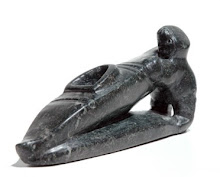
What you see above is a miniature replica of the same boat I'm building, the DNM lc. 43 (KOG plate #31). It belongs to the growing qajaq collection of naval miniaturist extraordinaire, fellow paddler, angler, cook (his mahi mahi sashimi has become a bit of a legend...), SOF builder (what he paddles in the pic below) and nice guy, Rafa.

Rafa is a true expert in traditional sailing craft from the Mediterranean coast, particularly llaguts and the like, and he's reproduced at reduced scale quite a few of them. Then, he discovered traditional qajaqs and turned his talent to them, producing outstanding miniatures of different types at a truly remarkable pace. He brought them to the past kayaking gathering in Santander and checking out the latest additions, chatting about design features and the reasons behind them and generally admiring the beautiful little boats was one of the good moments of the long weekend.

As usual, I didn't make the pictures. They were taken by Javier, a new paddling friend I met in Santander. Another highlight of those days.

miércoles, 25 de marzo de 2009

Ship shape


As, I guess, has happened to all first-time qajaq builders before, I found it pleasantly surprising how, all of a sudden, two long planks of wood suddently start looking boat-like when put on the forms.

Moreover, I did the string thingy to check for simmetry and alignment and I found I was within Cunningham's "terrific job" range. I wouldn't have taken any bets on that.


Not that everything went perfectly well and smooth, of course. The MDF forms did give some problems. Midly gloomy predictions by master craftsman Xevi (check his blogs, the qajaq, the umiaq and... well the other things... Very much worth it) tended to come true. A couple of the middle forms had one of their external arms broken and the bow and stern forms did tend to spread at the top (next ones, if there are next ones, will not be open in the middle).

Fortunately, friend and fellow builder Alfonso (whose qajaq and paddle building blog I also recommend heartily) had brought to my attention the contraption in the picture below when my project was little more than worries and a long list of potential problems in my mind and how to deal with a changing gunwale flare was prominent among them. It is basically two pieces of wood joined on top and bottom by Spanish windlasses, thus allowing for separate adjustment of pressure on the gunwale's upper and lower edge.


It looks like it was inspired by (or provided itself the inspiration for) some instrument of torture, but, in any case, the thing has worked very well in persuading the gunwales to take the desired, varying angles. I really like it. If there are more qajaqs in the future, I think I'll go with simpler, sturdier forms coupled with this thing. Thank you, Alfonso.

The tendency to open of the end forms was cured using cam buckle straps around them. The straps also proved generally useful to help hold the overall shape. Oh, I also did the kerf cutting magic so the gunwales' ends make proper contact. And started cutting and adjusting the first straight deck beam (rasps and files, what a great invention...).

So, there is progress. I have something I can look at and think of a qajaq and I have learned for the future.

I have almost forgotten the moments of panic by now.