Disclaimer: This is the English avatar (not exactly a translation, though close) of a Spanish-language blog. I am not a native English speaker, so I would ask readers to bear kindly with this attempt (possibly too bold) and the mistakes it will entail and to accept the apologies for them I offer in advance here.


Mostrando entradas con la etiqueta paddle report. Mostrar todas las entradas

jueves, 31 de diciembre de 2009

Hiatus

A much welcome stint of paddling interrupted for a while the building (I've already returned to it, however, and there's some progress. Ribs and keel stringer installed. Working on the chine stringers. Updates soon).

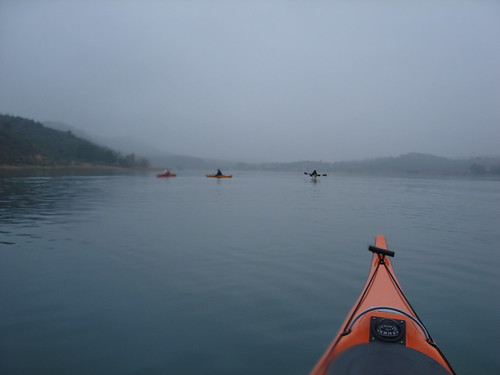
I went to Gijón, northern coast, to paddle with Xabier (whose beautiful S&G Night Heron accompanies my own Fun Run Sedna in the pic above) and a bunch of other local paddlers. They are forming a sea kayak association (AKDMA, Asociación Kayak de Mar Asturias) somewhat after the example of the neighboring and successful AGKM and ACKM in Galicia and Cantabria, respectively. By the way, a sizeable group of Cantabrian paddlers showed up as well.

Saturday afternoon, however, Xabier and I were on our own. Conditions were interesting. Close to 3 m of steep (7 s period) waves and NE F4-5 winds. We briefly tested the situation out in Gijón Bay and promptly turned back to El Arbeyal, our very protected launch beach for a bit of surfing (rarely possible there). Fun time and some nice rides (mostly Xabier's) that ended up with my swimming when a successful roll after a capsize righted me just in a time for a second wave to play with me. Proof (not that it was needed) that solid back sculling can be very useful and is not just a trick to impress onlookers.

Sunday morning, the air was definitely colder (snow later in the day) and things at sea were, if anything, slightly more interesting. The videos should give an idea, though, as always, it now looks tamer on them than it did when in the middle of it.

We started on the intended route, nonetheless, with sea and wind from the bow. That I found quite manageable, but I worried about a substantial return leg with those same conditions as following, or rear quartering seas, which I always find far less comfortable. Therefore, when after a brief while a small group proposed turning back, I adhered with an inner sigh of relief.

Back at El Arbeyal, it was some more surfing and a bit of rolling and it was fun. Added to the paddling was the time spent with Xabier and his family around Gijón enjoying talk, food and cider. All in all, a great weekend.

Note: As usual, pics and vids not mine. They are here courtesy of Edu, a Cantabrian fellow paddler.

viernes, 20 de febrero de 2009

Paddling

There have been several fun days out paddling with friends. Each outing has been interesting for its own reasons. Valdecañas included one night out camping. It provided nice landscape, lunch in the ruins of a Roman temple, abundant and varied birdlife (cranes, geese, diverse ducks,vultures...) and an otter, which only Xabier saw (sort of fitting, as he was in his baidarka). Oh, it also included a late algae bloom which had us paddling in algae soup for substantial stretches. I could have done without that.

Denia was my introduction to a section of the Mediterranean coast that was surprisingly beautiful. Tall cliffs dotted with caves, clear water, and landmarks such Cabo de La Nao, easternmost point of Spain. El Burguillo was a nice day out with friends which the snow (we have had lots of it this winter, at least for our standards...) and the clear day made particularly beautiful.

As always, others took the pictures shown below.

miércoles, 19 de noviembre de 2008

Firsts VII: Iqyax


As previously stated, I'm fortunate with my paddling friends. As also said, one of the reasons, by no means the only or major one, is that they build great SOF kayaks and I get to try them. The latest instance of that is an Aleutian baidarka that Xabier launched a week or so ago. His fourth SOF boat since March, by the way. He's a fast, possibly compulsive builder, I tell you.

So we went back to Cazalegas, the reservoir where Xabier's first Greenland qajaq also made her maiden voyage. Same place, but the weather today was much nicer and the public this time was reduced to just me. Another difference was that birds were by no means as plentiful. However, the marsh harriers that accompanied us in the previous visit were around again.


Aleutian baidarkas seem to be shrouded in some kind of mystique. Certainly, they have quite unique looks. They are long and skinny and have bifid bows (shared with some other Alaskan kayaks, by the way) and distinctive sterns. They are also supposed to be very fast, almost mysteriously so. Nonetheless, for some reason I have never been part of the baidarka cult. I like them, sure, and find them attractive, but regard them as "just" another great traditional kayak among a good bunch of them.

However, now I have had direct contact with one and, when experienced live, the boat has a definite imposing presence that pictures had failed to convey for me. At 5,70 m long, she comes out as a kayak of obvious substance. The 48 cm beam in no way diminishes this impression. Actually, it somehow seems to accentuate it. Plus, of course, for a not very skilled paddler like myself, such a narrow boat introduces an initial element of, let's say, respect. You know, when you cannot help but keep wondering for how long you will stay upright on that thing.


Well, as it turned out, for quite long. Surprise, surprise (at least for me): it is stable. Almost incredibly so. You can heel her quite a bit (more than the pics show and without bracing) and the feeling is always reassuringly solid. It may have to do with Xabier's lowering of the keelson's height and the consequently flatter hull. Whatever the reason, we both felt perfectly comfortable paddling her in almost no time. It is also fast, but with such a boat that's expected, almost a given.

Xabier's thinks he built more rocker into her than would be typical for a baidarka. After looking at some line drawings and pictures of other replicas I'm not sure if I see much of a difference there. In any case, the balance between tracking and maneuverability he's achieved seems a good one. She tracks well, but is still quite responsive to leans and, for a boat of her size, actually felt quite agile to me.

Xabier has definitely departed from the baidarka canon in the aft deck. Typically, it would be peaked as the foredeck and about flush with it. The cockpit would be, consequently, horizontal. Xabier has opted for a common modification in modern baidarka semi-replicas and has built a lower, flat deck aft of a now slanted cockpit. At the very least, this change makes entering and exiting the boat easier or, depending on your flexibility, even just possible. It may also help with some rolls.

All in all, I absolutely enjoyed the experience. It felt a really good boat, at least for the flat water conditions we had. The real test will be the ocean, of course, but, although going purely on gut feeling here, I sort of think she will behave well there too.

I had a fabulous time.

viernes, 7 de noviembre de 2008

Arousa

About almost three months ago, I spent three great days in a sort of micro-paddling expedition in Galicia. It's been a while, certainly, but the memories are still vivid and truly pleasant.

It was Xabier's idea. The Xabier who built the first SOF qajaq I ever tried, and that by now has another two Greenland style boats under his belt, a pretty much finished Aleutian baidarka that will soon hit the water plus some non-kayaks. A one-man shipyard, I tell you.

He invited some friends and, after a worrying meteo forecast scared us off a very attractive, but rather exposed stretch of the coast of Asturias, we opted for the large Arousa Inlet. Arousa offered an abundance of interesting, yet sheltered, paddling opportunities and a chance to cross to the beautiful islands at its mouth and poke our noses out into Atlantic, weather permitting.

Thus, on a fine friday afternoon, Xabier, Jesus, Carlos, Luismi and yours truly, set out with the ebb tide from right below the Towers of Catoira, an impossing fortress built on the banks of the Ulla River to guard against Viking and Saracen naval raids. A hundred km and two impromptu bivouacs later, we returned to the same spot on sunday's noon. The weather was actually much better than expected, we did reach the islands and enjoyed a truly benign Atlantic. The area is truly a paddling jewel and we had a wonderful time. It all went so well and smoothly that we decided we would go for something bigger next summer. A week or so. Plans are still a tad vague, but the intention is firm. Indeed, I've learned that both Xabier and Carlos have already purchased tents adequate for kayaking expeditions.

I really look forward to it.


Note: No cameras on this trip. The few images there area come from Carlos' cellular phone and appear here thanks to his kindness.

lunes, 18 de agosto de 2008

Qajaq & Frito


I guess I am very fortunate. I have friends that build traditional Skin-On-Frame kayaks and then invite me to paddle alongside them, show me fine paddling locations, allow me to try their boats and put up with my childish glee with a smile...

One of those friends, Alfonso, is the person who carved and lent me the first Greenland paddle I ever held and used during the II Costa Calida Kayak Meeting (which he also organized). A true key point in my kayaking. Recently, he has tackled a more ambitious project and has built a great-looking qajaq (the process is documented in the highly recommended "Groenlandeses Murcianos" blog, though only those able to read Spanish will fully enjoy it). Since the Meeting, Alfonso had offered several times to show me some of his favorite paddling spots and, finally, some ten days ago I was able to accept his generous invitation.

On a warm afternoon, Alfonso, Roberto and I paddled a remarkably beautiful part of the Segura River. Upstream first (which, at times, needed a judicious mix of muscle and wise use of eddies) and then downstream back to our put in. River paddling was great fun, requring just the right amount of attention. In fact, I enjoyed it so much, we did it again the next morning. The place was the same, but the experience wasn't, as river, light, sounds, smells had changed.

Boats changed too. The first time I paddled a Fun Run Draken, a stable, comfortable and quite fast kayak that should make a great expedition boat, but the second one I was on Alfonso's qajaq. And I simply fell in love with it. It was amazingly responsive.
It glided smoothly, accelerated quickly and carved tight turns. Mostly, it just allowed a degree of precise control I had not felt before and I had a wonderful time. I now dream about hard-chined boats.


And best of all was Alfonso's hospitality which went quite farther than allowing me to use his boats. He took me and threw me right in the middle of his extended family to share the good times they were having together. I certainly did. I played with the kids, talked with the adults, tasted the great local cuisine and, simply, enjoyed being there.

I told you, I am fortunate.

jueves, 22 de mayo de 2008

Firsts V: Qajaq


It's been over two months since another of those first times that still seem to remain reasonably frequent in my paddling. Thanks to the kindness of Xabier, boat-builder extraordinaire and fellow inland paddler and Kayak de Mar forumite, I had the chance to paddle a beautiful (see the pics, don't just take my word for it) Skin-On-Frame, West Greenland style qajaq that he had just finished.

The qajaq's maiden voyage took place in Cazalegas, a nice, not too distant reservoir (which I was also visiting for the first time) which proved quite interesting in the bird-watching department. The male of a couple of Marsh Harriers seemed to take interest in us and stayed nearby for good chunks of the outing and in the groves at the reservoir's tail the group, i.e., Xabier, Juan Antonio (whose photographs illustrate this entry), Jesús and I saw Night and Purple Herons.

It was a bright, if somewhat windy morning when we departed from near the dam. The wind kept increasing as we paddled, bringing clouds and stirring a substantial chop. Following wind and following chop, I guess you could say as they both came straight from our sterns. When after somewhat over 6 km, we reached the end of one of the reservoir's tails, Xabier and I switched boats and I entered for the first time a SOF kayak to paddle her on the return leg of the trip.

I was surprised by how solid and robust she felt. I had abundantly read and heard that SOFs were not fragile, quite the contrary actually, but for some reason it hadn't really clicked in my mind. Well, it has now. My first thought was a pleased confirmation of how well my Greenland paddle went with the boat, but that was quickly superseded by the first hand experience of what a deep V hull does to initial stability (pretty much killing it, if I trust my first impression), but also of how secondary stability quickly comes to the rescue.

And as soon as I had the boat moving, sensations completely changed. It suddenly felt very stable and hardly tilted at all. By now the wind blowing straight against us was quite strong, to the delight of some windsurfers that had suddenly appeared. We had to work to make progress. The qajaq kept her course as if on rails, but responded well to moderate edging. It also was a great opportunity to verify that, yeah, a totally flat deck means a rather wet ride even if all you are pinching is shortish lake chop.

I enormously enjoyed those 6 km back to the put in and I think that, had I built the boat myself, the feeling would have come dangerously close to pure bliss. I don't know yet when, but I now know that one day I will just have to build a SOF.

viernes, 4 de abril de 2008

Firsts III: Ortigueira

Note: The pictures below were taken by Luis, from Ponferrada, who kindly allowed me to use them.

Easter 2008 brought a diversity of fresh kayaking experiences of the good (very good, actually) kind packed in four days spent in the Santa Marta de Ortigueira area in Galicia, northwestern Spain.

I met new fellow kayakers, making what I hope will become new friends, and got first hand contact with the AGKM (Asociación Galega de Kaiak de Mar), an interesting and promising initiative in the national sea kayaking scene. My recently finished first Greenland paddle got its first use in saltwater. For the first time, I could lay my hands on SOF boats, a Greenland-style kayak made by one of my woodworking gurus, Paco García, and an Aran currach that travelled all the way from Barcelona, and I paddled in new, very nice places.


Under AGKM's gentle wing, what initially was to be just a gathering of friends at Ortigueira, quickly and spontaneously grew into something quite large that included semi-strangers like me, a surf-kayak clinic, a Greenland paddle-making workshop and Greenland ropes. In spite of this, the event very purposefully stuck to its original informal nature and a "We are all organizers here" motto. Of course, some people actually worked while I, for example, contributed by having a jolly good time, but I believe the prevalent spirit, a sort of gently-steered anarchy, was indeed the intended one. It worked remarkably well.

It was my first kayaking exposure to our northern sea. That stretch of Atlantic Ocean that we call Mar Cantábrico (Cantabrian Sea) and others the southern end of the Bay of Biscay. It is a beautiful coast. Over most of its length, it is conveniently sprinkled with rías, river inlets that afford protected waters where guys like me can still enjoy very nice outings when conditions out there get hairy. In Galicia, the coast's western end and where we were, those inlets become even more frequent and substantial. It is also reasonably dotted by villages (often quaint and picturesque) ports where you can stop for refreshment and good food. It is truly a wonderful area for sea kayaking.


As first exposures go, it was a tad limited, though, as the weather did not fully cooperate. For me, F6-7 winds and truly big seas (4-7 m) accompanied by rain and hail squalls made paddling unappealing in the inlets and pretty much suicidal in the ocean on Saturday and Sunday. Fortunately, there was the paddle-making shop and a lovely piece of red cedar to keep me happily busy.

On Thursday, we all paddled together and poked our collective nose out of the Ortigueira inlet from the small port of Espasante. Conditions, though milder than they would become later during the weekend, were not exactly comfortable (F4-5, about 2-3 m breaking waves) for a group of mixed skill levels such as we were and we soon returned to sheltered waters. Lesson learned, next day we split according to our abilities and daring. A minority faced F5 (later 6) wind and 3-4 m waves in an excursion along the coast. Prudently, I went with the majority and the currach for a more sedate trip down the very pretty O Barqueiro inlet to the beautiful port of Bares taking the Greenland stick out for its first trip.

Bares happens to be the northernmost port in Spain and there are occasional statements that it is also the oldest one still in operation. Its megalithic jetty is often dated to the VIIIth century BCE and attributed to either Phoenician traders or, less commonly, local peoples. However, recent scholarships is critically reviewing those claims and a consensus on a roman origin may be emerging. In any case, its an intriguing and impressive structure that has formed the beach where we disembarked for a beer and a bite of something good in a nearby tavern. We returned with a helping high tide, winds increasing to the point of occasional annoyance and growing esteem and comfort with my Greenland paddle on my part. By the end of the trip, I was totally hooked on it. For a good while, I paddled near the currach watching it move against a backdrop of cliffs, woods, secluded beaches, coves and small fishing villages in the opposite shore and having just the greatests of times.

It is truly a wonderful area for sea kayaking.

miércoles, 20 de febrero de 2008

Firsts II (Riaño)


In a previous entry I ranted about my first paddle of 2008 entailing many "first times" and taking it as an omen for the year. Well, it seems I wasn't too wrong. The year keeps bringing novelties into my paddling. I now use a new Euro paddle which has made a major difference (for good) and which I definitely love. A Greenland stick (first thing I've built wit my hands ever, I think) is finished and waiting to be thoroughly tested (inevitably, there will more on both in the near future in this space). I've also visited a couple of new paddling spots, including Riaño reservoir last weekend, and that happened to be my first camping kayak trip (even if for just one night).


I took part in the third edition of the Riaño Winter Paddle. Riaño Reservoir is a largish man-made lake, reasonably high (about 1200 m asl) up among the Cantabrian Mountains in Northern Spain. Seemingly, it is also pretty much the only body of water in the country combining sufficient size and nice scenery with the potential for severe paddling conditions during winter. As such, it has been identified by some enterprising Spanish kayakers as a convenient place to test both gear and oneself and acquire experience in cold weather paddling not too far from home.


Lots of snow (Riaño I) and lots of rain at near-freezing temperatures (Riaño II) provided the sought after hardships during the two previous editions, making them a definite success. This year, however, once the morning fog cleared, we had to endure a bright, sunny day that quickly melted the night's frost and left us little choice other than enjoying the scenic landscape. Ouch. Some relief came in the form of a rather cold night at the camp (around -5º C) followed by a frosty sunrise. I suppose that trying to stuff gear into dry bags frozen rigid might qualify as a bit of a challenge.


I fear I may lack a truly adventurous spirit. I must confess that the kindly weather did not disappoint me at all and that I cherished the chance to just have a good time. Also, being, as said, my first kayak camping trip, there were some personal tests anyway that I thought covered the challenge area very adequately in my case. Choosing and managing camping gear, clothing, food and water and loading it all in my 450 cm long Creus by Fun Run Kayaks (it will soon have its well-deserved entry, too) felt enough of a trial for now.


I am happy to report it all worked very well and that my boat did live up to its builder's claim (no surprise here) of good loading capacity. Everything needed for a comfortable winter overnighter fitted neatly into the two bulkheads and with some room to spare. I had no need to carry stuff on the deck (other than the pump, paddle float and small dry bag with snacks that always go there), something I don't like at all (I might be a tad anal about it...). Hatches and dry bags did their thing: nothing got wet. Balmier conditions, requiring less and less bulky gear, sharing a tent or, if it really comes to it, some minor cluttering of the deck with cargo, should free abundant space for food and water and, thus, allow for substantially longer outings.

I eagerly look forward to them.


NOTE: The pictures above were taken by Miguel (Mijeliño) and Jaime (Borrasca) who have kindly allowed me to use them. At Jaime's blog you'll find a more extensive chronicle of the trip and links to more photographs.

viernes, 11 de enero de 2008

Firsts

t


After almost two months where all my paddling had been mental (courtesy of colds, busy schedules and awful weather connected in clever succession) I did some of the real thing on Thursday. Despite unpromising forecasts, the weather behaved very reasonably and it turned out a lovely outing.

Upon some idle musing, I noticed that a really substantial number of "first times" were happening for me on this particular paddle. Not only it was my first in 2008, more relevantly, it would also be my first longer than 20 km. Substantially longer in fact, as we were aiming for a bit over 42 km for the round trip. I was also going to be trying my brand new Chota mukluks, paddling with gloves and visiting Bolarque Reservoir for the first time and, while I had already paddled with Jaime (aka Borrasca), the other two members of the group I knew only from the forum and hadn't met in person. Oh, and it was just by chance, a matter of a couple of hours, that I wasn't using a completely new paddle as well.


With some many experiments going on at once, I was half expecting one or more to go terribly wrong. Well, I'm happy to report that didn't happen. Due to a delayed put in and a desire to get back in the car while some daylight remained, Jaime and I ended paddling a bit less than 40 km (Sergio and Arturo, our more eager and faster companions, added some 5-6 extra kms to that), but I didn't feel particularly tired and, to my surrprise, neither arms nor shoulders were aching (not even sore or stiff) the following day. I did "notice" the trapezius, rhomboids and obliques, though nothing really serious either. Arturo and Sergio proved to be very nice chaps. The mukluks performed splendidly, keeping my feet dry and warm and, while I didn't particularly care for the feeling of increased loom thickness elicited by the gloves, I found it an acceptable trade off for warmer hands.


Bolarque turned out to be a beautiful place. Lonely, quiet and peaceful, it sported great landscape, clear waters and abundant bird life. There were coots, mallards and cormorants by the hundreds, but also gadwalls and a few pochards, numerous grey herons, kingfishers and vultures in the steep rock walls on the banks. The fog that prevailed for most of the day lend the area a melancholic air which I thought enhanced its looks. Jaime and Sergio sought to register the sights in a number of pictures, including those they have kindly lent me to illustrate this entry.

All in all, a very enjoyable paddle. I'll take it as a good omen for 2008.