And I have just realized that said bay is what I know as the mouth of the O Barqueiro Inlet and that I was paddling just there this past Easter.
lunes, 21 de abril de 2008
Link (IV). There's not a moment to lose
And I have just realized that said bay is what I know as the mouth of the O Barqueiro Inlet and that I was paddling just there this past Easter.
miércoles, 16 de abril de 2008
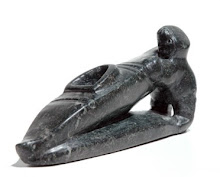
Poor Kayak
The kayakluk was retrieval craft for ice-edge hunting. About 1.8 m long, 0.8 m wide and 38 cm deep, it was made with the old skins from a normal kayak and lacked a rigid interior frame. It was carried folded on the hunter's back and, once on the ice edge, it was filled up with snow and the thongs on its upper part were tightened. The paddler sat on top with legs stretched and employed a short paddle. According to its users, the poor kayak's main advantages were light weight and ease of transport. It seems that carrying a normal kayak on a sled often damaged its skin.
It does look like a moccasin, doesn't it?
sábado, 12 de abril de 2008
Firsts IV: Paatit
Since then, it has seen water (fresh, this time) once again. Another windy day, even more so than the first one and, hence, another chance to appreciate what it can do for you in such conditions. And to become totally addicted to the absolutely silent stroke you can achieve with it and the much valued chances to come close to wildlife that it provides. Oh, for some 5 km of that outing and thanks to the kindness of Xabier, its builder, I could match my paatit with a Greenland-style SOF kayak on the return leg of its maiden voyage (another "first" to ramble upon in the near future). Lovely
The stick (obeche wood = ayous = samba and a few other names) has ended up 234 cm long and 7.8 cm wide for a weight of 850 gr. I'm absurdly fond of it.
viernes, 4 de abril de 2008
Firsts III: Ortigueira
Note: The pictures below were taken by Luis, from Ponferrada, who kindly allowed me to use them.
Easter 2008 brought a diversity of fresh kayaking experiences of the good (very good, actually) kind packed in four days spent in the Santa Marta de Ortigueira area in Galicia, northwestern Spain.
I met new fellow kayakers, making what I hope will become new friends, and got first hand contact with the AGKM (Asociación Galega de Kaiak de Mar), an interesting and promising initiative in the national sea kayaking scene. My recently finished first Greenland paddle got its first use in saltwater. For the first time, I could lay my hands on SOF boats, a Greenland-style kayak made by one of my woodworking gurus, Paco García, and an Aran currach that travelled all the way from Barcelona, and I paddled in new, very nice places.

Under AGKM's gentle wing, what initially was to be just a gathering of friends at Ortigueira, quickly and spontaneously grew into something quite large that included semi-strangers like me, a surf-kayak clinic, a Greenland paddle-making workshop and Greenland ropes. In spite of this, the event very purposefully stuck to its original informal nature and a "We are all organizers here" motto. Of course, some people actually worked while I, for example, contributed by having a jolly good time, but I believe the prevalent spirit, a sort of gently-steered anarchy, was indeed the intended one. It worked remarkably well.
It was my first kayaking exposure to our northern sea. That stretch of Atlantic Ocean that we call Mar Cantábrico (Cantabrian Sea) and others the southern end of the Bay of Biscay. It is a beautiful coast. Over most of its length, it is conveniently sprinkled with rías, river inlets that afford protected waters where guys like me can still enjoy very nice outings when conditions out there get hairy. In Galicia, the coast's western end and where we were, those inlets become even more frequent and substantial. It is also reasonably dotted by villages (often quaint and picturesque) ports where you can stop for refreshment and good food. It is truly a wonderful area for sea kayaking.

As first exposures go, it was a tad limited, though, as the weather did not fully cooperate. For me, F6-7 winds and truly big seas (4-7 m) accompanied by rain and hail squalls made paddling unappealing in the inlets and pretty much suicidal in the ocean on Saturday and Sunday. Fortunately, there was the paddle-making shop and a lovely piece of red cedar to keep me happily busy.
On Thursday, we all paddled together and poked our collective nose out of the Ortigueira inlet from the small port of Espasante. Conditions, though milder than they would become later during the weekend, were not exactly comfortable (F4-5, about 2-3 m breaking waves) for a group of mixed skill levels such as we were and we soon returned to sheltered waters. Lesson learned, next day we split according to our abilities and daring. A minority faced F5 (later 6) wind and 3-4 m waves in an excursion along the coast. Prudently, I went with the majority and the currach for a more sedate trip down the very pretty O Barqueiro inlet to the beautiful port of Bares taking the Greenland stick out for its first trip.
Bares happens to be the northernmost port in Spain and there are occasional statements that it is also the oldest one still in operation. Its megalithic jetty is often dated to the VIIIth century BCE and attributed to either Phoenician traders or, less commonly, local peoples. However, recent scholarships is critically reviewing those claims and a consensus on a roman origin may be emerging. In any case, its an intriguing and impressive structure that has formed the beach where we disembarked for a beer and a bite of something good in a nearby tavern. We returned with a helping high tide, winds increasing to the point of occasional annoyance and growing esteem and comfort with my Greenland paddle on my part. By the end of the trip, I was totally hooked on it. For a good while, I paddled near the currach watching it move against a backdrop of cliffs, woods, secluded beaches, coves and small fishing villages in the opposite shore and having just the greatests of times.
It is truly a wonderful area for sea kayaking.
I met new fellow kayakers, making what I hope will become new friends, and got first hand contact with the AGKM (Asociación Galega de Kaiak de Mar), an interesting and promising initiative in the national sea kayaking scene. My recently finished first Greenland paddle got its first use in saltwater. For the first time, I could lay my hands on SOF boats, a Greenland-style kayak made by one of my woodworking gurus, Paco García, and an Aran currach that travelled all the way from Barcelona, and I paddled in new, very nice places.
Under AGKM's gentle wing, what initially was to be just a gathering of friends at Ortigueira, quickly and spontaneously grew into something quite large that included semi-strangers like me, a surf-kayak clinic, a Greenland paddle-making workshop and Greenland ropes. In spite of this, the event very purposefully stuck to its original informal nature and a "We are all organizers here" motto. Of course, some people actually worked while I, for example, contributed by having a jolly good time, but I believe the prevalent spirit, a sort of gently-steered anarchy, was indeed the intended one. It worked remarkably well.
It was my first kayaking exposure to our northern sea. That stretch of Atlantic Ocean that we call Mar Cantábrico (Cantabrian Sea) and others the southern end of the Bay of Biscay. It is a beautiful coast. Over most of its length, it is conveniently sprinkled with rías, river inlets that afford protected waters where guys like me can still enjoy very nice outings when conditions out there get hairy. In Galicia, the coast's western end and where we were, those inlets become even more frequent and substantial. It is also reasonably dotted by villages (often quaint and picturesque) ports where you can stop for refreshment and good food. It is truly a wonderful area for sea kayaking.
As first exposures go, it was a tad limited, though, as the weather did not fully cooperate. For me, F6-7 winds and truly big seas (4-7 m) accompanied by rain and hail squalls made paddling unappealing in the inlets and pretty much suicidal in the ocean on Saturday and Sunday. Fortunately, there was the paddle-making shop and a lovely piece of red cedar to keep me happily busy.
On Thursday, we all paddled together and poked our collective nose out of the Ortigueira inlet from the small port of Espasante. Conditions, though milder than they would become later during the weekend, were not exactly comfortable (F4-5, about 2-3 m breaking waves) for a group of mixed skill levels such as we were and we soon returned to sheltered waters. Lesson learned, next day we split according to our abilities and daring. A minority faced F5 (later 6) wind and 3-4 m waves in an excursion along the coast. Prudently, I went with the majority and the currach for a more sedate trip down the very pretty O Barqueiro inlet to the beautiful port of Bares taking the Greenland stick out for its first trip.
It is truly a wonderful area for sea kayaking.
jueves, 27 de marzo de 2008
Eskimo Roll III. Unangan
Be warned: this is going to be long and rambling. Keep reading at your own risk.
Thanks to Dr. Key I've read a Sea Kayaker's article by Jeff Dickrell discussing whether or not the Aleuts rolled their baidarkas (alright, their iqyax, to be precise). Obviously, clearcut evidence is lacking (there wouldn't be much to discuss otherwise, would it?). Literary references are contradictory and, in some pro-roll cases, vague or indirect. Actually, the Unangam people are not alone in this relative uncertainty regarding their rolling abilities. For example, among those reporting on Chugach paddling practices, only Kaj Birket-Smith (quoted by David Zimmerly in his very nice book Qayaq ) stated that they were able to roll their kayaks (which were called baidarka too and shared eye-catching similarities such as a bifid bow with Aleutian craft, but that, otherwise, must have handled rather differently in terms of stability, speed, etc...).
In any case, Dickrell seems to conclude that the Aleuts were in fact able to roll, but that the maneuver was not widespread. I can certainly agree with that (which, as I am no expert, is pretty irrelevant, but this is my blog after all...) and would like to perhaps add some minor evidence. Around 1840, Bishop Ivan Veniaminov (quoted again in Zimmerly's Qayaq) wrote: "Thus, today there are extremely few, if any, of the former riders who, when their boats capsized, could set them right side up by themselves or who could set... upright with a skillful motion of the oar without emerging from the baidarka"

I find it a bit surprising that this was not mentioned in Sea Kayaker as it is quite accessible and Dickrell does include other quotes from Veniaminov (a major source on Aleutian etnography in general and kayaking in particular). Certainly, that quote it's not like a videoclip of an Aleut rolling, but considering the time Bishop Veniaminov spent in American Russia and his interest and devotion towards the natives and their culture, it does carry some weight for me. Additionally, it seems to nicely fit the suggested picture of an existing, but not widely practiced roll. Moreover, it also appears to hint of a rapidly fading skill and this matches well my own speculation (idle and without base, sure) about why the Aleut roll seems to have been rare, if it existed at all.
Dickrell does some tentative theorizing on the reasons for this. In essence, he seems to suggest that a roll was not very necessary because the Aleuts rarely capsized. That they were very, very good at bracing (at paddling, in general) and that, in addition, they used rocks as ballast which both reduced the likelihood of tipping over and made rolling very difficult if, in spite of those precautions, they were overturned.

It might have been so, but, though I am clearly way out of my depth here, I can't help but wonder if that's the whole of it. For one thing, the information I've seen has left me with the impression that, after all, capsizes were not that extraordinary for the Aleuts. Accounts of hunters lost at sea do not seem uncommon and Veniaminov reported (once again, quoted in Qayaq) Aleut self-rescue techniques that relied on inflated sea-lion or seal stomachs as floats to bail out (if needed) and re-enter an overturned baidarka (it brought to my mind our own paddle-float procedures). Veniaminov states that those floats were an "indispensable" part of the baidarka's equipment. To me this tends to suggest that the Unangan might have contemplated capsizing as something one should be prepared to deal with, though, admittedly, the bladders were also used to transport water and could function as flotation bags in case of need too.
Moreover, it seems to me that capsize likelihood is not the only, maybe not even the major determinant of whether a group of native kayakers rolled or not. For example, King Island (readers of this blog might remember) and Nunivak Island kayakers who paddled rather stable craft developed roll maneuvers for their wide boats and single blade paddles. In contrast, the Mckenzie Delta Inuvialuit and the Caribou Eskimo that used some of the most unstable of all traditional kayaks (substantially more so than Aleutian baidarkas), did not roll at all (nor used ballast).

In my opinion, more factors must have come into play. Rolling is not the only response to a capsize and how likely was for a group of arctic paddlers to develop a roll and rely primarily on it rather than on alternative techniques may have depended on the whole context of kayak use. Whether the kayakers tended to operate alone or in groups, water depth, temperature and proximity to shore, the prey they hunted and the tools they used to do it (presence or not of harpoon lines that may tangle, for instance) and, possibly, a host of other circumstances were likely relevant. Thus, Mckenzie Delta and Caribou Inuit kayakers seem to have often hunted in groups and not too far from shore and rescue procedures among Caribou Inuit, as reported by E Arima (see this previous entry), seem to have often involved the help of a nearby hunting partner and transportation to shore.
In this regard and coming back to the Aleuts, it seems that European contact had a major impact on their kayaking practices. The Russian promyshlenniki, fur traders and hunters, started appearing on the area around 1743. Soon they were exploiting the natives, pretty much enslaving them and forcing the hunters to focus on catching sea otters for them. Those sea otter hunts were carried out in groups and using two-person baidarkas rather than the single-paddler one that apparently were the dominant hunting craft before the Russians' arrival. Veniaminov (once again! And once again quoted in Qayaq) wrote: "The two-hatched baidarka was always in use among the Aleuts, but only for the transfer of light freight or for the riding on the sea of an old man with a child, but even up to the present day, there has never been an instance of two young and healthy rowers of their own will riding out in hunt of the otter in a two-hatched boat. This was regarded as shameful".
In stark contrast with these words, later graphic material overwhelmingly shows two or three-person baidarkas (a Russian invention to carry cargo or a passenger) often in sizeable parties. Although possible, it is trickier to roll a double than a single and if hunting was now often done in groups, reasonably prompt assistance could be counted on. Under these new circumstances, rolling would become less useful and the incentive to invest the effort required to master it would be reduced.

In the Aleutians, the promyshlenniki and the deep and rapid changes they caused, seem to have preceded the etnographers. I wonder if, when Europeans interested in the culture and traditions of the inhabitants, and not merely in exploiting them, arrived they found an already changed society where, presumably among other things, rolling a baidarka (maybe never a popular practice) was largely a thing of the past, as Veniaminov's words seem to suggest.

In any case, Dickrell seems to conclude that the Aleuts were in fact able to roll, but that the maneuver was not widespread. I can certainly agree with that (which, as I am no expert, is pretty irrelevant, but this is my blog after all...) and would like to perhaps add some minor evidence. Around 1840, Bishop Ivan Veniaminov (quoted again in Zimmerly's Qayaq) wrote: "Thus, today there are extremely few, if any, of the former riders who, when their boats capsized, could set them right side up by themselves or who could set... upright with a skillful motion of the oar without emerging from the baidarka"
I find it a bit surprising that this was not mentioned in Sea Kayaker as it is quite accessible and Dickrell does include other quotes from Veniaminov (a major source on Aleutian etnography in general and kayaking in particular). Certainly, that quote it's not like a videoclip of an Aleut rolling, but considering the time Bishop Veniaminov spent in American Russia and his interest and devotion towards the natives and their culture, it does carry some weight for me. Additionally, it seems to nicely fit the suggested picture of an existing, but not widely practiced roll. Moreover, it also appears to hint of a rapidly fading skill and this matches well my own speculation (idle and without base, sure) about why the Aleut roll seems to have been rare, if it existed at all.
Dickrell does some tentative theorizing on the reasons for this. In essence, he seems to suggest that a roll was not very necessary because the Aleuts rarely capsized. That they were very, very good at bracing (at paddling, in general) and that, in addition, they used rocks as ballast which both reduced the likelihood of tipping over and made rolling very difficult if, in spite of those precautions, they were overturned.
It might have been so, but, though I am clearly way out of my depth here, I can't help but wonder if that's the whole of it. For one thing, the information I've seen has left me with the impression that, after all, capsizes were not that extraordinary for the Aleuts. Accounts of hunters lost at sea do not seem uncommon and Veniaminov reported (once again, quoted in Qayaq) Aleut self-rescue techniques that relied on inflated sea-lion or seal stomachs as floats to bail out (if needed) and re-enter an overturned baidarka (it brought to my mind our own paddle-float procedures). Veniaminov states that those floats were an "indispensable" part of the baidarka's equipment. To me this tends to suggest that the Unangan might have contemplated capsizing as something one should be prepared to deal with, though, admittedly, the bladders were also used to transport water and could function as flotation bags in case of need too.
Moreover, it seems to me that capsize likelihood is not the only, maybe not even the major determinant of whether a group of native kayakers rolled or not. For example, King Island (readers of this blog might remember) and Nunivak Island kayakers who paddled rather stable craft developed roll maneuvers for their wide boats and single blade paddles. In contrast, the Mckenzie Delta Inuvialuit and the Caribou Eskimo that used some of the most unstable of all traditional kayaks (substantially more so than Aleutian baidarkas), did not roll at all (nor used ballast).
In my opinion, more factors must have come into play. Rolling is not the only response to a capsize and how likely was for a group of arctic paddlers to develop a roll and rely primarily on it rather than on alternative techniques may have depended on the whole context of kayak use. Whether the kayakers tended to operate alone or in groups, water depth, temperature and proximity to shore, the prey they hunted and the tools they used to do it (presence or not of harpoon lines that may tangle, for instance) and, possibly, a host of other circumstances were likely relevant. Thus, Mckenzie Delta and Caribou Inuit kayakers seem to have often hunted in groups and not too far from shore and rescue procedures among Caribou Inuit, as reported by E Arima (see this previous entry), seem to have often involved the help of a nearby hunting partner and transportation to shore.
In stark contrast with these words, later graphic material overwhelmingly shows two or three-person baidarkas (a Russian invention to carry cargo or a passenger) often in sizeable parties. Although possible, it is trickier to roll a double than a single and if hunting was now often done in groups, reasonably prompt assistance could be counted on. Under these new circumstances, rolling would become less useful and the incentive to invest the effort required to master it would be reduced.
In the Aleutians, the promyshlenniki and the deep and rapid changes they caused, seem to have preceded the etnographers. I wonder if, when Europeans interested in the culture and traditions of the inhabitants, and not merely in exploiting them, arrived they found an already changed society where, presumably among other things, rolling a baidarka (maybe never a popular practice) was largely a thing of the past, as Veniaminov's words seem to suggest.
domingo, 9 de marzo de 2008
Link (III)
During early June of the year 1788, the Spanish frigate Princesa commanded by Esteban José Martínez and her companion, the packet-boat San Carlos under Gonzalo López de Haro, explored Prince William Sound. On 18th June, both ships, after having dispatched launches for survey work were sailing close near the southwestern end of Montague Island. On a note for his diary's entry for the day, Jose María de Narváez, a pilot who had commanded one of the launches, referred to the watercraft used by the inhabitants of the area in these terms:

"Their canoes are shaped like a harp and sheathed on the outside with little span ropes. The frames of the canoes are fabricated on the inside of very thin ribs of wood, woven into a perfectly engineered shape. In the same style, they have an enclosure in which there is a round hatch, like the mouth of an earthen jar. The Indian gets into this. No matter how much swell there is, he travels free of getting any of his body wet. His arms are free to row with small oars."

I believe that Narváez was speaking of the kayaks of the Chugach people who still live in the area.

miércoles, 20 de febrero de 2008
Firsts II (Riaño)

In a previous entry I ranted about my first paddle of 2008 entailing many "first times" and taking it as an omen for the year. Well, it seems I wasn't too wrong. The year keeps bringing novelties into my paddling. I now use a new Euro paddle which has made a major difference (for good) and which I definitely love. A Greenland stick (first thing I've built wit my hands ever, I think) is finished and waiting to be thoroughly tested (inevitably, there will more on both in the near future in this space). I've also visited a couple of new paddling spots, including Riaño reservoir last weekend, and that happened to be my first camping kayak trip (even if for just one night).

I took part in the third edition of the Riaño Winter Paddle. Riaño Reservoir is a largish man-made lake, reasonably high (about 1200 m asl) up among the Cantabrian Mountains in Northern Spain. Seemingly, it is also pretty much the only body of water in the country combining sufficient size and nice scenery with the potential for severe paddling conditions during winter. As such, it has been identified by some enterprising Spanish kayakers as a convenient place to test both gear and oneself and acquire experience in cold weather paddling not too far from home.

Lots of snow (Riaño I) and lots of rain at near-freezing temperatures (Riaño II) provided the sought after hardships during the two previous editions, making them a definite success. This year, however, once the morning fog cleared, we had to endure a bright, sunny day that quickly melted the night's frost and left us little choice other than enjoying the scenic landscape. Ouch. Some relief came in the form of a rather cold night at the camp (around -5º C) followed by a frosty sunrise. I suppose that trying to stuff gear into dry bags frozen rigid might qualify as a bit of a challenge.

I fear I may lack a truly adventurous spirit. I must confess that the kindly weather did not disappoint me at all and that I cherished the chance to just have a good time. Also, being, as said, my first kayak camping trip, there were some personal tests anyway that I thought covered the challenge area very adequately in my case. Choosing and managing camping gear, clothing, food and water and loading it all in my 450 cm long Creus by Fun Run Kayaks (it will soon have its well-deserved entry, too) felt enough of a trial for now.

I am happy to report it all worked very well and that my boat did live up to its builder's claim (no surprise here) of good loading capacity. Everything needed for a comfortable winter overnighter fitted neatly into the two bulkheads and with some room to spare. I had no need to carry stuff on the deck (other than the pump, paddle float and small dry bag with snacks that always go there), something I don't like at all (I might be a tad anal about it...). Hatches and dry bags did their thing: nothing got wet. Balmier conditions, requiring less and less bulky gear, sharing a tent or, if it really comes to it, some minor cluttering of the deck with cargo, should free abundant space for food and water and, thus, allow for substantially longer outings.
I eagerly look forward to them.

NOTE: The pictures above were taken by Miguel (Mijeliño) and Jaime (Borrasca) who have kindly allowed me to use them. At Jaime's blog you'll find a more extensive chronicle of the trip and links to more photographs.
Suscribirse a:
Entradas (Atom)
