
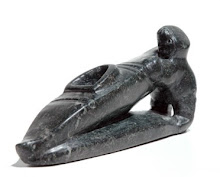
 Thanks to Dr. Key I've read a Sea Kayaker's article by Jeff Dickrell discussing whether or not the Aleuts rolled their baidarkas (alright, their iqyax, to be precise). Obviously, clearcut evidence is lacking (there wouldn't be much to discuss otherwise, would it?). Literary references are contradictory and, in some pro-roll cases, vague or indirect. Actually, the Unangam people are not alone in this relative uncertainty regarding their rolling abilities. For example, among those reporting on Chugach paddling practices, only Kaj Birket-Smith (quoted by David Zimmerly in his very nice book Qayaq ) stated that they were able to roll their kayaks (which were called baidarka too and shared eye-catching similarities such as a bifid bow with Aleutian craft, but that, otherwise, must have handled rather differently in terms of stability, speed, etc...).
In any case, Dickrell seems to conclude that the Aleuts were in fact able to roll, but that the maneuver was not widespread. I can certainly agree with that (which, as I am no expert, is pretty irrelevant, but this is my blog after all...) and would like to perhaps add some minor evidence. Around 1840, Bishop Ivan Veniaminov (quoted again in Zimmerly's Qayaq) wrote: "Thus, today there are extremely few, if any, of the former riders who, when their boats capsized, could set them right side up by themselves or who could set... upright with a skillful motion of the oar without emerging from the baidarka"

I find it a bit surprising that this was not mentioned in Sea Kayaker as it is quite accessible and Dickrell does include other quotes from Veniaminov (a major source on Aleutian etnography in general and kayaking in particular). Certainly, that quote it's not like a videoclip of an Aleut rolling, but considering the time Bishop Veniaminov spent in American Russia and his interest and devotion towards the natives and their culture, it does carry some weight for me. Additionally, it seems to nicely fit the suggested picture of an existing, but not widely practiced roll. Moreover, it also appears to hint of a rapidly fading skill and this matches well my own speculation (idle and without base, sure) about why the Aleut roll seems to have been rare, if it existed at all.
Dickrell does some tentative theorizing on the reasons for this. In essence, he seems to suggest that a roll was not very necessary because the Aleuts rarely capsized. That they were very, very good at bracing (at paddling, in general) and that, in addition, they used rocks as ballast which both reduced the likelihood of tipping over and made rolling very difficult if, in spite of those precautions, they were overturned.

It might have been so, but, though I am clearly way out of my depth here, I can't help but wonder if that's the whole of it. For one thing, the information I've seen has left me with the impression that, after all, capsizes were not that extraordinary for the Aleuts. Accounts of hunters lost at sea do not seem uncommon and Veniaminov reported (once again, quoted in Qayaq) Aleut self-rescue techniques that relied on inflated sea-lion or seal stomachs as floats to bail out (if needed) and re-enter an overturned baidarka (it brought to my mind our own paddle-float procedures). Veniaminov states that those floats were an "indispensable" part of the baidarka's equipment. To me this tends to suggest that the Unangan might have contemplated capsizing as something one should be prepared to deal with, though, admittedly, the bladders were also used to transport water and could function as flotation bags in case of need too.
Moreover, it seems to me that capsize likelihood is not the only, maybe not even the major determinant of whether a group of native kayakers rolled or not. For example, King Island (readers of this blog might remember) and Nunivak Island kayakers who paddled rather stable craft developed roll maneuvers for their wide boats and single blade paddles. In contrast, the Mckenzie Delta Inuvialuit and the Caribou Eskimo that used some of the most unstable of all traditional kayaks (substantially more so than Aleutian baidarkas), did not roll at all (nor used ballast).

In my opinion, more factors must have come into play. Rolling is not the only response to a capsize and how likely was for a group of arctic paddlers to develop a roll and rely primarily on it rather than on alternative techniques may have depended on the whole context of kayak use. Whether the kayakers tended to operate alone or in groups, water depth, temperature and proximity to shore, the prey they hunted and the tools they used to do it (presence or not of harpoon lines that may tangle, for instance) and, possibly, a host of other circumstances were likely relevant. Thus, Mckenzie Delta and Caribou Inuit kayakers seem to have often hunted in groups and not too far from shore and rescue procedures among Caribou Inuit, as reported by E Arima (see this previous entry), seem to have often involved the help of a nearby hunting partner and transportation to shore.
 In this regard and coming back to the Aleuts, it seems that European contact had a major impact on their kayaking practices. The Russian promyshlenniki, fur traders and hunters, started appearing on the area around 1743. Soon they were exploiting the natives, pretty much enslaving them and forcing the hunters to focus on catching sea otters for them. Those sea otter hunts were carried out in groups and using two-person baidarkas rather than the single-paddler one that apparently were the dominant hunting craft before the Russians' arrival. Veniaminov (once again! And once again quoted in Qayaq) wrote: "The two-hatched baidarka was always in use among the Aleuts, but only for the transfer of light freight or for the riding on the sea of an old man with a child, but even up to the present day, there has never been an instance of two young and healthy rowers of their own will riding out in hunt of the otter in a two-hatched boat. This was regarded as shameful".
In stark contrast with these words, later graphic material overwhelmingly shows two or three-person baidarkas (a Russian invention to carry cargo or a passenger) often in sizeable parties. Although possible, it is trickier to roll a double than a single and if hunting was now often done in groups, reasonably prompt assistance could be counted on. Under these new circumstances, rolling would become less useful and the incentive to invest the effort required to master it would be reduced.

In the Aleutians, the promyshlenniki and the deep and rapid changes they caused, seem to have preceded the etnographers. I wonder if, when Europeans interested in the culture and traditions of the inhabitants, and not merely in exploiting them, arrived they found an already changed society where, presumably among other things, rolling a baidarka (maybe never a popular practice) was largely a thing of the past, as Veniaminov's words seem to suggest.


